Відгуки і рецензії читачів
Поки немає відгуків


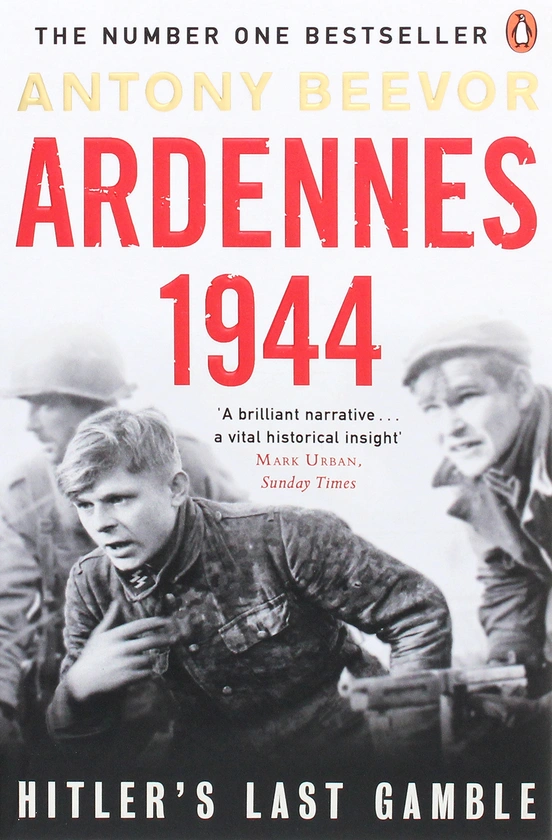
Ardennes 1944: Hitler's Last Gamble is a gripping military history of the Battle of the Bulge, Hitler’s last major offensive in the West and one of the most dramatic campaigns of the Second World War. On 16 December 1944, German forces attacked through the snow-covered forests and ravines of the Ardennes, hoping to split the Allied armies, drive toward Antwerp, and change the course of a war already closing in on Nazi Germany. The hook is stark: a desperate gamble, a stunned Allied front, and more than a million men drawn into a battle fought in freezing mud, fog, fear, and confusion.
Ardennes 1944: Hitler's Last Gamble Antony Beevor offers readers a detailed, human-centered account from a historian known for major works on Stalingrad, Berlin, and D-Day. The book combines operational clarity with the voices of soldiers and civilians, showing not only the movement of armies but also the terror of those caught between them. Its value lies in the way it explains why the offensive was launched, how it achieved surprise, and why it ultimately helped exhaust the Wehrmacht beyond recovery.
The book begins with the strategic situation late in 1944. The Allies had advanced across Western Europe after Normandy, while the Soviet army was pressing from the east. Hitler believed a sudden strike in the Ardennes could fracture the Allied coalition, seize Antwerp, and force a political crisis among the Western powers. Many German generals doubted the plan, yet the offensive went ahead, fueled by desperation, secrecy, and the hope that one violent blow might delay defeat.
Beevor follows the shock of the attack as American units, often thinly spread and unprepared for such a massive assault, faced German panzer armies in harsh winter conditions. The battle unfolded through forests, villages, crossroads, and frozen roads where confusion was constant and communications were fragile. The plot of the history is not fictional, but it carries the tension of a thriller because the outcome depends on delay, endurance, weather, logistics, and the courage of units ordered to hold when everything around them seemed to be breaking.
The book also gives strong attention to the civilian experience in Belgium and Luxembourg. For people living in the path of the offensive, the return of German forces meant fear, flight, reprisals, and uncertainty. The battle was not only a clash between armies; it entered homes, farms, churches, and towns. This focus broadens the conflict, showing how military decisions made at the highest level turned ordinary winter landscapes into places of panic and loss.
In the middle of the narrative, Ardennes 1944: Hitler's Last Gamble book becomes a study of command under pressure. Allied leaders had to respond to intelligence failure, weather that limited air power, supply problems, rumors of German infiltrators, and the psychological impact of surprise. On the German side, the offensive revealed both tactical skill and strategic illusion. The deeper conflict lies in the gap between Hitler’s fantasy of reversal and the material exhaustion of the army he ordered forward.
The characters in this history range from senior commanders to young soldiers, medics, tank crews, prisoners, and civilians. Beevor is especially effective when he moves from large-scale maps to individual experience: hunger, frostbite, fear of capture, anger after massacres, and the bitter recognition that the Western Front could become as savage as the war in the East. The battle’s brutality is presented as part of the military story, not as a separate moral footnote.
The atmosphere is cold, brutal, and tense. Snow, fog, forests, night movements, roadblocks, and sudden armored attacks create a sense of danger that rarely lifts. The Ardennes setting becomes central to the story: terrain and weather shape every decision, from the speed of German columns to the ability of American defenders to hold key positions. The reader feels how winter itself became a weapon.
The major themes include desperation, command failure, endurance, revenge, civilian vulnerability, and the collapse of military illusion. The book explores why men continued to fight when the wider war was already turning decisively against Germany, and how Allied soldiers responded when surprise gave way to anger and determination. It also shows how war crimes and fear of reprisals hardened attitudes on both sides.
The style is precise, vivid, and narrative-driven. Beevor balances strategy with ground-level detail, making troop movements understandable without losing sight of the people inside the battle. The pacing follows the offensive from sudden breakthrough to slowing advance, Allied stabilization, and the eventual failure of the German gamble. This gives the book the momentum of a campaign history while preserving the emotional weight of personal testimony and battlefield chaos.
What lingers after reading is the sense of a battle fought at the edge of collapse. Ardennes 1944: Hitler's Last Gamble does not present the offensive as a near-miracle that almost saved Germany. Instead, it shows a violent, costly operation that caused enormous suffering, briefly shook Allied confidence, and consumed resources the Wehrmacht could never replace. The tragedy is sharpened by the knowledge that so many died in a gamble already detached from reality.
This book is for readers interested in Second World War history, battlefield narrative, command decisions, and the human experience of combat. It will appeal to an audience that wants more than a summary of the Battle of the Bulge. Readers who value military detail, political context, and accounts of soldiers and civilians under extreme pressure will find it especially compelling.
One reason to read this book is its ability to connect battlefield events with the larger collapse of Nazi Germany. The offensive was designed to restore initiative, but Beevor shows how ambition, denial, and dwindling resources produced catastrophe. The reader sees not only what happened, but why the plan was so dangerous from the start.
Another reason is the attention given to the soldiers caught inside the gamble. American troops surprised in their positions, German units ordered forward under impossible expectations, and civilians trapped in the path of the attack all become part of the same harsh story. This human scale makes the military history more immediate and memorable.
The book also stands out because it does not soften the savagery of the campaign. The Ardennes battle involved heroism, panic, massacre, retaliation, courage, confusion, and exhaustion. By holding these realities together, the narrative avoids easy triumphalism and gives the campaign its full historical weight.
Ardennes 1944: Hitler's Last Gamble is a powerful choice for readers who want a vivid, serious, and deeply researched account of Hitler’s final offensive in the West. It invites you into the frozen forests and desperate command rooms of December 1944, where one last gamble brought immense suffering and helped break the fighting strength of the Wehrmacht for good.