Відгуки і рецензії читачів
Поки немає відгуків


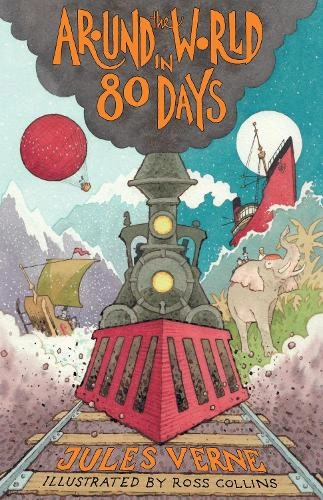
Around the World in Eighty Days by Jules Verne is an adventure novel about a wager that turns travel into a race against the clock. Phileas Fogg believes he can circle the globe within a precise deadline. He leaves London with his newly hired valet, Passepartout, expecting careful planning to carry him through an unpredictable world.
Trains, steamships and unexpected forms of transport move the companions across continents, but missed connections and local obstacles repeatedly threaten Fogg’s timetable. Detective Fix adds another complication by following the traveller under the mistaken belief that he is a bank robber.
The contrast between Fogg’s composure and Passepartout’s more impulsive temperament gives the story humour as well as suspense. Practical intelligence, loyalty and the willingness to help others matter alongside speed. Verne uses the expanding transport networks of his era to imagine an increasingly connected world whose details still refuse to obey a schedule.
Fogg’s precision gives the journey its initial shape. He treats a remarkable challenge as something that can be approached through calculation and decisive action, even when his companions find the plan alarming. The world continually tests that confidence. A timetable describes what should happen, while weather, obstacles and human behaviour determine what actually happens. Each difficulty forces a choice about whether to wait, improvise or accept a different kind of risk.
Passepartout makes those choices feel less abstract. Newly employed by a man whose habits appear exceptionally regular, he finds himself in an adventure that leaves little room to settle into routine. His curiosity and emotional responses give readers a perspective different from Fogg’s reserve. Their contrasting temperaments create misunderstandings, but they also allow loyalty to become something demonstrated under pressure rather than assumed from the start.
Fix’s pursuit changes the meaning of movement again. What Fogg regards as a practical stage in fulfilling his wager can appear to the detective as evidence of an attempted escape. Readers follow the friction between those interpretations while knowing that interruptions may threaten the deadline. Verne’s setting captures the promise of modern transport alongside the uncertainty that remains when people cross unfamiliar places, depend on connections and must make judgments with incomplete information.
This printed book suits readers who enjoy journeys, comic misunderstandings and a clear narrative challenge. Each stage introduces a different problem, while the approaching deadline keeps the episodes connected. The story offers a lively way to explore themes of confidence, friendship and resourcefulness through characters who must keep adapting when plans fail.