Відгуки і рецензії читачів
Поки немає відгуків


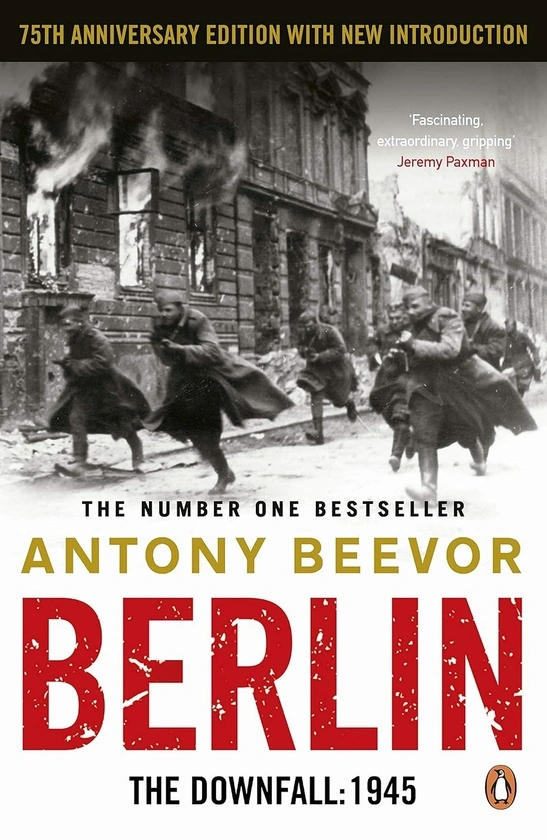
Berlin: The Downfall 1945 is a harrowing work of military history about the final collapse of the Third Reich and the battle that brought the war in Europe to its brutal end. Antony Beevor reconstructs the Soviet advance, the Nazi leadership’s refusal to face defeat, and the catastrophe that engulfed soldiers and civilians as Berlin became the last stage of Hitler’s destroyed empire. The hook is uncompromising: in the ruins of a regime built on violence, millions of ordinary people were caught between vengeance, fanaticism, fear, and survival.
Berlin: The Downfall 1945 Antony Beevor offers readers a deeply researched narrative of the Battle of Berlin, first published in 2002 and widely recognized as one of the major modern accounts of the end of the Second World War in Europe. The book combines operational history with human testimony, showing the decisions of commanders alongside the experiences of refugees, women, children, soldiers, prisoners, and civilians trapped in the nightmare of 1945.
The narrative follows the final months of the war as the Red Army moved toward Berlin from the east and Nazi Germany descended into military, political, and moral collapse. Hitler and the Nazi leadership continued to demand resistance even when defeat was inevitable, turning cities, villages, and civilian populations into sacrifices for an ideology that had already doomed them. The result was a campaign marked by desperation, chaos, and immense human suffering.
Beevor shows how the Soviet drive toward Berlin was shaped by years of German brutality on the Eastern Front. Revenge, propaganda, exhaustion, and command pressure all contributed to the atmosphere of the final offensive. The book does not reduce the Red Army to a single image; it presents soldiers as victors, survivors, avengers, liberators, and perpetrators, caught in a campaign where discipline, rage, and trauma collided.
The plot of this history moves through collapsing fronts, refugee columns, bombed cities, command bunkers, street fighting, and the final encirclement of Berlin. Military decisions are presented alongside the consequences they produced on the ground. Tanks, artillery, infantry assaults, and political orders become part of a broader story about a society breaking apart while its leaders continued to issue impossible commands.
In the middle of the account, Berlin: The Downfall 1945 book becomes more than a battle narrative. It becomes an examination of what happens when a state refuses reality until its people pay the price. Nazi officials often blocked evacuation, civilians fled in terror, and the final phase of the war brought mass rape, pillage, executions, suicide, hunger, and displacement on a vast scale. The conflict is not only between armies, but between ideology and human life.
The characters in this history include Stalin, Hitler, Soviet commanders, German generals, Party officials, front-line soldiers, nurses, refugees, and Berliners trying to endure the impossible. Beevor’s strength lies in moving between these levels without losing the human scale. The fall of Berlin is shown not only as the defeat of a capital, but as the collapse of an entire system of power, lies, and cruelty.
The atmosphere is bleak, urgent, and terrifyingly vivid. Ruined streets, burning buildings, frozen roads, crowded shelters, military panic, and the claustrophobia of Hitler’s bunker create a sense of history closing in from all directions. The book’s emotional force comes from the contrast between grand strategy and individual vulnerability: maps show advances, but people experience hunger, fear, violation, and loss.
The major themes include fanaticism, revenge, civilian suffering, command failure, propaganda, endurance, moral collapse, and the savage consequences of total war. The book explores how Nazi crimes shaped the violence that followed, while also refusing to ignore the atrocities committed during the Soviet advance. It asks how societies descend into brutality, how soldiers behave after years of dehumanizing war, and how civilians survive when authority abandons them.
The style is narrative, detailed, and dramatic without losing historical seriousness. Beevor combines archival material, diaries, eyewitness accounts, and military analysis to create a broad yet readable picture of the final battle. The pacing follows the tightening ring around Berlin, but the book also pauses for intimate moments of fear, courage, self-sacrifice, and despair, allowing the reader to understand the battle as both operation and catastrophe.
What lingers after reading is the sense of a city crushed under the weight of history. Berlin: The Downfall 1945 does not present victory as clean or simple. The destruction of Nazi Germany was necessary, but the path to that end was filled with suffering that cannot be reduced to triumph. The book’s power lies in making the reader confront the cost of the final weeks and the human wreckage left behind.
This book is for readers interested in Second World War history, the Eastern Front, the Battle of Berlin, and the final days of Nazi Germany. It will appeal to an audience that values detailed military narrative, political context, and accounts that include both battlefield operations and civilian experience.
One reason to read this book is its ability to connect the final battle with the wider moral history of the war. The fall of Berlin was not an isolated event; it was the consequence of invasion, occupation, ideological violence, and years of destruction. Beevor shows how the road to Berlin was paved by decisions made long before the first Soviet troops entered the city.
Another reason is the attention given to civilians. The book makes clear that the end of a war can be as terrifying as its beginning for those without power. Women, children, refugees, forced laborers, and ordinary Berliners appear not as background, but as central witnesses to the collapse around them.
The book also stands out because it balances operational clarity with moral unease. It explains troop movements, command rivalries, and strategic goals, yet never lets the reader forget the savagery beneath the maps. The result is a history that is both readable and deeply disturbing.
Berlin: The Downfall 1945 is a powerful choice for readers who want to understand the last, catastrophic act of the war in Europe. It invites you into the ruins of Berlin, where ideology met defeat, armies closed in, and millions of people discovered what happens when a regime built on violence finally collapses into the fire it created.