Відгуки і рецензії читачів
Поки немає відгуків


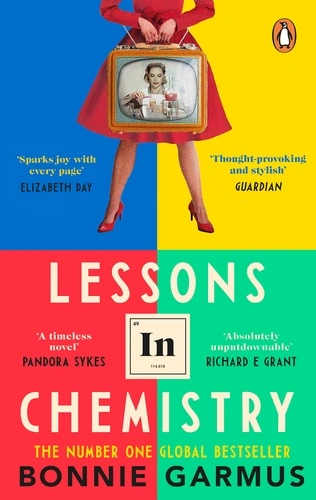
Lessons in Chemistry is a witty, moving, and fiercely intelligent novel about science, sexism, and the power of one woman refusing to accept the limits placed around her. Elizabeth Zott is a chemist in early 1960s Southern California, working in a world where men call themselves rational while treating equality as if it were an absurd experiment. When professional injustice forces her out of the laboratory and onto a television cooking show, Elizabeth brings chemistry with her, turning recipes into lessons in matter, change, and self-respect.
Lessons in Chemistry Bonnie Garmus offers readers a bestselling debut novel centered on Elizabeth Zott, a brilliant and unconventional heroine whose refusal to perform helplessness becomes quietly revolutionary. The story blends humor, heartbreak, social critique, and warmth as Elizabeth moves from research scientist to reluctant host of Supper at Six, where overlooked housewives begin to hear something more radical than dinner instructions: their lives can change, molecule by molecule.
Elizabeth Zott is not the kind of woman her colleagues know how to categorize. She is exact, disciplined, brilliant, and uninterested in pretending that inferior treatment is natural. At Hastings Research Institute, her scientific mind should earn respect, but the all-male culture around her sees her gender before it sees her work. Her conflict begins in the gap between what she knows she is capable of and what the world insists women are allowed to become.
The plot follows Elizabeth through professional setbacks, personal loss, and the constant need to defend her right to be taken seriously. She is a chemist not because it sounds impressive, but because she believes in evidence, structure, and truth. That belief shapes everything she does, from research to cooking to motherhood. Her scientific worldview becomes a form of resistance against a society built on assumptions that collapse the moment anyone tests them.
When Elizabeth becomes the host of Supper at Six, she does not transform into the cheerful domestic personality television expects. Instead, she treats cooking as chemistry and addresses her audience as intelligent people capable of understanding more than household routine. This gives the novel its most delightful reversal: the kitchen, often used to confine women, becomes Elizabeth’s platform for education, dignity, and rebellion.
In the middle of the novel, Lessons in Chemistry book becomes more than a story about a woman succeeding despite prejudice. It becomes a broader portrait of how change spreads. Elizabeth’s viewers begin to see themselves differently, not because she flatters them, but because she refuses to underestimate them. Her lessons reach women who have spent years being dismissed, and the show becomes a quiet catalyst for self-recognition.
The characters around Elizabeth add tenderness, humor, and emotional complexity. Calvin Evans, a brilliant scientist, recognizes Elizabeth’s mind in a way few others do. Mad, Elizabeth’s daughter, brings curiosity and seriousness beyond her years. Six-Thirty, the family dog, adds an unusual and memorable perspective on loyalty, grief, and intelligence. Together, these figures make the story feel both sharp and deeply humane.
The atmosphere is bright, sharp, and full of controlled comic energy, with a strong undercurrent of anger at injustice. The 1960s setting creates a world of laboratories, television studios, kitchens, rowing, schoolrooms, and social expectations that constantly attempt to reduce women to smaller roles. Yet the novel’s tone is never only bleak; its humor gives Elizabeth’s defiance sparkle and momentum.
The major themes include gender equality, scientific thinking, motherhood, grief, love, ambition, education, and the courage to challenge authority. The book explores how institutions preserve unfairness by calling it tradition, and how one person’s refusal to cooperate can expose the weakness of that tradition. It also asks what it means to raise a child, build a career, and love deeply while remaining true to oneself.
The style is brisk, funny, and emotionally generous. Bonnie Garmus combines social satire with heartfelt character work, allowing the novel to be both entertaining and pointed. The prose often treats absurdity with a straight face, which suits Elizabeth perfectly: she lives in an irrational world and answers it with reason, precision, and unforgettable calm.
What lingers after reading is the sense that change can begin in ordinary rooms. Lessons in Chemistry does not present transformation as a single grand speech. It grows through experiments, meals, conversations, refusals, questions, and the insistence that women are not problems to be managed but minds to be respected.
This novel is for readers who enjoy smart historical fiction, feminist storytelling, memorable heroines, and books that balance humor with emotional depth. It will appeal to an audience that likes unconventional characters, workplace conflict, found family, scientific curiosity, and stories where a woman’s intelligence becomes the engine of change.
One reason to read this novel is Elizabeth Zott herself. She is precise, stubborn, vulnerable, and inspiring without being softened into easy likability. Her strength comes from clarity: she knows that unfairness is not natural, intelligence is not masculine, and respect should never depend on obedience.
Another reason is the way the book turns chemistry into a language for life. Cooking, parenting, grief, attraction, and social change all become reactions shaped by pressure, heat, timing, and transformation. This gives the story a distinctive style and makes its title feel meaningful on every level.
The novel also stands out because it treats its supporting characters with affection. Even while Elizabeth drives the plot, the people and animals around her create emotional warmth and surprise. Their stories deepen the book’s atmosphere and keep its satire connected to real tenderness.
Lessons in Chemistry is a joyful and thought-provoking choice for readers who want a novel with wit, heart, and a heroine who refuses to be reduced. It invites you into a world where a cooking show becomes a classroom, a scientist becomes a public voice, and the formula for change begins with the radical idea that every mind deserves to be taken seriously.