Відгуки і рецензії читачів
Поки немає відгуків


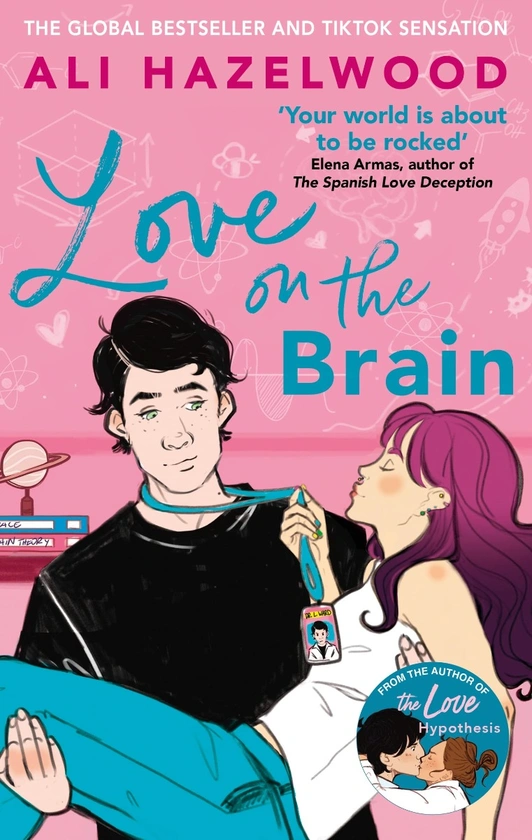
Love on the Brain is a witty STEM romance about a neuroscientist, her grad-school nemesis and a NASA neuroengineering project that turns professional rivalry into a dangerously distracting attraction.
Love on the Brain Ali Hazelwood follows Bee Königswasser, a scientist guided by the question “What would Marie Curie do?”, as she accepts the career opportunity of a lifetime only to discover that her co-lead is Levi Ward, the man she believes made his dislike for her painfully clear years ago.
The plot begins when Bee is offered the chance to lead BLINK, a neuroengineering project connected with NASA and designed around performance-enhancing technology for astronauts. For a scientist trying to build a serious career in a field where women are too often underestimated, this opportunity should feel like pure victory. Bee is brilliant, passionate and deeply committed to her work, but she also knows how exhausting it can be to fight for space in systems that do not always listen.
The complication is Levi Ward. In grad school, Bee believed Levi hated her, and that belief has shaped the way she sees him ever since. He is tall, intense, brilliant and apparently impossible to avoid now that they must co-lead the same project. Their professional relationship begins under the pressure of old assumptions, guarded communication and the painful memory of being dismissed by someone whose opinion once mattered more than Bee would like to admit.
The central conflict grows when the project starts going wrong. Bee’s equipment disappears, staff members ignore her and the institutional obstacles around her begin to feel less like bad luck and more like sabotage. At the same time, Levi’s behaviour no longer fits the enemy role she has assigned to him. He backs her ideas, supports her work and seems far more attentive than a nemesis should be.
In the middle of the narrative, Love on the Brain book becomes a workplace romance built on scientific ambition, miscommunication and the thrill of realizing that an old story may have been wrong. Bee must decide whether Levi is truly softening into an ally or whether hope is making her misread the data. Their attraction develops through collaboration, respect and the growing sense that chemistry can be just as hard to ignore as evidence.
The characters are shaped by their professional world. Bee is smart, funny, guarded and determined not to let sexism, academic precarity or past disappointment define her. Levi is controlled, serious and difficult to interpret, but his actions increasingly reveal loyalty, admiration and emotional depth. Their conflict is not only romantic; it is also about trust, recognition and the courage to put both career and heart on the line.
Published in 2022, the novel is Ali Hazelwood’s second full-length romance after The Love Hypothesis and part of her well-known STEM-centered romantic fiction. It combines enemies-to-lovers tension with workplace stakes, feminist commentary and the pleasure of watching two highly intelligent people slowly realize that the strongest connection between them may not be rivalry at all.
The atmosphere is sharp, nerdy, romantic and full of professional tension. Labs, meetings, project deadlines, academic memories and NASA-linked research create a setting where every exchange between Bee and Levi carries both intellectual pressure and emotional charge.
The main themes include women in STEM, ambition, trust, miscommunication, bias, collaboration, vulnerability and the fear of being dismissed by the people whose respect matters most. The novel asks what happens when a woman who has trained herself to expect resistance begins to encounter support from the person she least expected to offer it.
Ali Hazelwood’s style is fast, humorous and emotionally direct, with a strong focus on banter, internal narration and romantic tension. The scientific setting gives the story its distinctive flavour, while Bee’s voice adds wit, frustration and charm. The result is a romance that feels brainy, playful and intimate at once.
The characters are memorable because their attraction is tied to competence. Bee and Levi do not connect only through physical chemistry; they challenge each other intellectually and professionally. That makes the romance satisfying because emotional trust develops alongside respect for each other’s work.
For the audience, the book offers a mix of workplace comedy, mystery, feminist frustration and slow-burn longing. It is a story where the games are not only romantic: power, credibility and professional recognition are also on the line.
This novel is ideal for readers who enjoy contemporary romance, STEM settings, enemies-to-lovers tension, workplace collaboration and heroines with sharp voices and serious ambitions. It suits an audience looking for a romance that is funny, sexy and smart without losing emotional warmth.
It will also appeal to fans of Ali Hazelwood’s science-centered love stories and to readers who enjoy plots where professional stakes and romantic vulnerability develop together. Anyone drawn to brilliant heroines, brooding heroes, banter, misread signals and slow recognition will find Bee and Levi’s story especially engaging.
Love on the Brain is a compelling choice for readers asking why read a STEM romance with humour and heart. It offers rivalry, science, sparks, workplace mystery and the satisfying discovery that sometimes the person you thought was against you may have been in your corner all along.