Відгуки і рецензії читачів
Поки немає відгуків


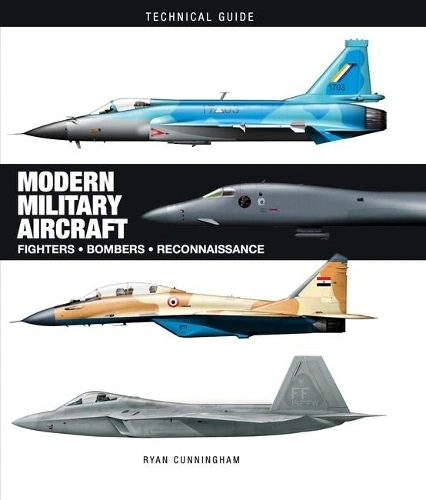
Modern Military Aircraft is a highly illustrated guide to the aircraft that define contemporary air power, from stealth fighters and strike platforms to reconnaissance aircraft, transport machines, airborne command systems, and attack helicopters.
Modern Military Aircraft Bing Chandler gives readers a clear visual route into the fast-changing world of military aviation, explaining how aircraft developed after the Cold War and why modern design now combines speed, sensors, weapons, survivability, and mission flexibility.
The book presents a broad survey of more than fifty key military aircraft associated with the last three decades of aviation development. Instead of treating aircraft as isolated machines, it organizes them by type, helping the reader understand how fighters, bombers and strike aircraft, transport and reconnaissance platforms, and helicopters serve different roles in the modern battlespace.
The central plot of this nonfiction volume is the evolution of air combat after the Cold War. Classic multirole fighters and strategic bombers did not disappear, but they were joined by stealth aircraft, improved airborne early warning and control platforms, advanced sensors, and systems designed for more complex joint operations. The result is a picture of aviation shaped by technology, doctrine, and changing global security needs.
Among the aircraft featured are the F-15 Strike Eagle, the F-35 Lightning II, Russia’s Kamov Ka-50 “Black Shark,” and China’s Shaanxi Y-9. These examples show the variety of modern military aviation: high-speed tactical fighters, stealth multirole platforms, heavily armed helicopters, and aircraft designed for detection, identification, transport, or battlefield support.
In the middle of the volume, Modern Military Aircraft book becomes especially useful for comparison. Each entry combines a brief development history with detailed artwork, key features, and specifications, allowing readers to connect what they see on the page with the role and performance of the aircraft being described.
The book includes more than 200 artworks and photographs, giving the subject strong visual impact. Aircraft are not reduced to names and numbers; their shapes, markings, weapons, rotor systems, engines, sensors, and configurations are presented in a way that helps readers recognize differences between types and understand why those differences matter.
Bing Chandler brings aviation and military knowledge to a guide designed for accessibility. The style is informative without becoming unnecessarily technical, making the book suitable for readers who want reliable detail but also enjoy the visual atmosphere of modern military aircraft in flight, on the ground, and in operational context.
The atmosphere is technical, visual, and contemporary. The book creates the sense of moving through a modern air force inventory, where every aircraft exists for a specific mission and every design reflects a different balance of speed, range, payload, protection, detection, and control.
The main themes include stealth technology, multirole capability, air superiority, strike power, reconnaissance, transport, battlefield support, and the relationship between aircraft design and military need. The conflict behind the subject is the constant pressure to adapt: aircraft must respond to new sensors, new weapons, new defenses, and new ways of coordinating operations across air, land, and sea.
The “characters” of the book are the aircraft themselves. A stealth fighter tells one story about invisibility and data; a strike aircraft tells another about precision and endurance; an attack helicopter shows the importance of low-level support and heavy armament; a transport or reconnaissance aircraft reveals how logistics and information can be as decisive as direct combat.
The style is structured for both browsing and learning. Readers can move by category, focus on a single aircraft, compare specifications, or study the artwork for visual clues. This makes the book practical as a reference and enjoyable as an illustrated overview for aviation enthusiasts.
Because the book covers several aircraft types rather than one narrow class, it gives a fuller picture of modern air power. It shows that contemporary military aviation is not defined by fighters alone, but by networks of machines that detect, move, protect, strike, and command.
This guide is ideal for military historians, aviation enthusiasts, model makers, students, and readers who want a clear introduction to modern aircraft without starting from specialist technical manuals. It suits anyone interested in how aircraft have changed since the 1980s and 1990s.
It will also appeal to readers who enjoy visual encyclopedias, aircraft recognition guides, defense technology, and comparisons between different national approaches to aviation. The audience includes both newcomers and experienced readers who want a compact, illustrated overview of aircraft roles, features, and development history.
Modern Military Aircraft is a strong choice for anyone asking why read an illustrated guide to contemporary aviation. It offers facts, atmosphere, visual detail, and practical structure in one volume, helping readers understand the aircraft that shape modern air power and the technology behind their roles.