Відгуки і рецензії читачів
Поки немає відгуків


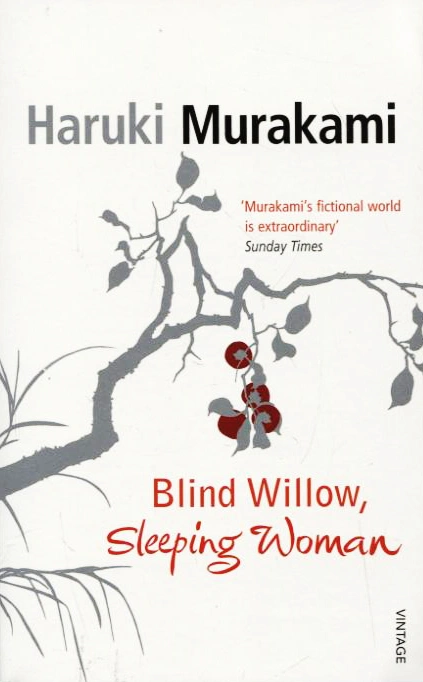
Murakami Blind Willow, Sleeping Woman is an atmospheric collection of short stories where ordinary life slips quietly into the surreal, and a single strange detail can open a door into another state of being. Haruki Murakami gathers tales of lonely men, unsettling memories, mysterious women, unexplained disappearances, odd jobs, wounded relationships, and realities that seem to bend after one unexpected turn. The hook is subtle but irresistible: in these stories, the world looks familiar until it suddenly reveals that it has been dreaming beside you all along.
Murakami Blind Willow, Sleeping Woman Haruki Murakami offers readers a wide-ranging short story collection first published in English in 2006, with translations by Philip Gabriel and Jay Rubin. The volume contains twenty-four stories written across different periods of Murakami’s career, including pieces that show his gift for blending loneliness, humor, memory, music, urban unease, and dreamlike transformation into fiction that feels both intimate and impossible to fully explain.
The collection opens a world where the smallest interruption can become the beginning of a mystery. A young man accompanies his cousin to a hospital and remembers a strange tale about tiny flies and a sleeping woman. A night watchman sees a mirror appear where it should not be and begins to fear his own reflection. A couple’s holiday meal of crab turns into something oddly unbalanced. A man follows instructions from a postcard to apply for a job, only to discover that an unknown password stands between him and a hidden employer.
These stories do not follow one central plot, but they share a recognizably Murakami-like emotional landscape. Characters drift through cafés, hospitals, apartments, hotels, workplaces, roads, and memories, often carrying a private absence they cannot easily name. Some are searching for people who have vanished. Some are trying to understand a past event that refuses to settle. Others simply follow a peculiar instruction or conversation until reality begins to tilt.
The collection’s themes are often quiet on the surface and uncanny underneath. Murakami is interested in how memory changes shape, how grief can hide inside routine, how desire and loneliness make people receptive to strange signals, and how the self may contain rooms that remain locked even to the person living there. The stories move between the everyday and the dreamlike without announcing the border, which makes the surreal feel almost natural.
In the middle of the collection, Murakami Blind Willow, Sleeping Woman book becomes a map of recurring Murakami concerns: lost women, uncertain men, cats, music, sleep, appetite, chance encounters, symbolic objects, and worlds that run parallel to ordinary life. Some stories feel like riddles, others like fragments of a novel glimpsed from the side, and others like memories told by someone unsure whether the most important thing happened in reality or in the mind.
The characters are rarely heroic in a conventional sense. They are observers, wanderers, listeners, husbands, cousins, workers, lovers, and strangers caught at moments of emotional suspension. Their conflicts are often internal: whether to follow an impulse, how to live with loss, why a relationship has become hollow, or what to do when an inexplicable event seems to reveal a hidden truth. This restraint gives the collection its lingering power.
The atmosphere is dreamlike, melancholy, and quietly disorienting. Murakami turns ordinary spaces into thresholds: a hospital corridor, a hotel room, a dining table, a mirror, a phone call, a postcard, a city street. Nothing needs to explode for the mood to change. A small detail is enough to make the familiar feel unreliable, as if another reality is pressing softly from behind the visible one.
The major themes include loneliness, memory, identity, desire, grief, coincidence, estrangement, and the unstable boundary between waking life and dream. The stories often ask how much of a person can remain hidden, even from those closest to them. They also explore how people respond to mysteries that may not have rational solutions, but still demand emotional attention.
The style is spare, precise, and hypnotic, with a calm surface that makes the strange elements more powerful. Murakami’s storytelling often begins in plain realism, then shifts by degrees into the surreal. His tone can be funny, sad, deadpan, eerie, or tender, sometimes in the same story. The result is fiction that feels easy to enter but difficult to leave behind.
What lingers after reading is not always an answer, but a sensation. Murakami Blind Willow, Sleeping Woman invites the reader to accept ambiguity as part of the experience. A story may end before the mystery is solved, but it leaves behind an emotional echo: a missing person, a half-remembered image, a conversation that changes meaning later, or a symbol that continues to move quietly in the mind.
This collection is for readers who enjoy literary short fiction, surreal realism, Japanese contemporary literature, and stories that privilege mood, atmosphere, and inner mystery over neat explanation. It will appeal to an audience that likes fiction where ordinary events become quietly uncanny and where the emotional truth of a story may matter more than a traditional ending.
One reason to read this collection is its range. The stories vary in tone, shape, and intensity, yet they all carry Murakami’s unmistakable sense of the uncanny. Some pieces are brief and elliptical, while others feel more expansive, but each one offers a glimpse into a world where the real and the surreal do not compete; they coexist.
Another reason is the emotional precision beneath the strangeness. The unusual images are memorable, but they work because they are connected to recognizable human feelings: isolation, longing, regret, curiosity, fear, and the desire to understand why something has shifted inside us. The surreal elements do not replace emotion; they reveal it from another angle.
The book also stands out because it rewards slow reading. These are stories to sit with, not puzzles to solve quickly. Their meanings often unfold after the final page, when an image or line returns unexpectedly. That aftereffect is part of the collection’s quiet magic.
Murakami Blind Willow, Sleeping Woman is a compelling choice for readers who want a collection that moves between the everyday and the mysterious with elegance and restraint. It invites you into rooms where mirrors may not be safe, memories may have hidden teeth, and the strange logic of dreams may be the most honest way to describe waking life.