Відгуки і рецензії читачів
Поки немає відгуків


Murakami Sputnik Sweetheart is a haunting, delicate novel about unrequited love, loneliness, and the mysterious distance between people who long for one another but cannot fully meet. Sumire is a young aspiring writer with a restless mind, oversized clothes, and a romantic imagination shaped by literature. She falls deeply in love with Miu, a glamorous older woman who seems to belong to another orbit entirely. Watching from the side is K, Sumire’s closest friend and quiet confidant, who carries his own impossible love for her. Then, on a small Greek island, Sumire vanishes.
Murakami Sputnik Sweetheart Haruki Murakami offers readers one of Haruki Murakami’s most intimate and mysterious novels, first published in Japanese in 1999 and later translated into English by Philip Gabriel. The book follows a triangle of desire where each person reaches toward someone unreachable, creating a story that is romantic, surreal, melancholy, and quietly devastating. Its promise is not a simple answer to a disappearance, but a meditation on what it means to be alone even when love is near.
Sumire is young, intense, and uncertain of how to live outside the world of books and private thoughts. She wants to become a writer, but her life is unfinished in every direction: emotionally, professionally, and romantically. Her friendship with K gives her someone to call late at night and speak to about life’s largest questions, especially desire, identity, and whether she should confess her feelings to Miu.
K is a schoolteacher and narrator whose calm voice hides a painful truth. He loves Sumire, but he understands that her attention is fixed elsewhere. His role in the story is both intimate and distant: he knows Sumire’s mind better than almost anyone, yet he cannot reach the part of her that longs for Miu. Through K, the novel captures the particular ache of loving someone who trusts you completely but does not want you in the same way.
Miu enters Sumire’s life as a figure of elegance, maturity, and mystery. She is successful, controlled, and outwardly composed, but her poise conceals a strange fracture in her past. Sumire’s attraction to her is immediate and transformative. She begins working with Miu, traveling with her, and imagining a version of herself that might finally become real through love. Yet Miu’s own emotional distance makes the relationship both magnetic and impossible.
In the middle of the novel, Murakami Sputnik Sweetheart book becomes more than a story of one-sided desire. The plot turns uncanny when K receives an urgent call from Miu on a Greek island: Sumire has disappeared without clear explanation. The search for her becomes a literal mystery, but also a symbolic descent into the gaps between people, memories, bodies, and selves. What happened to Sumire may be less important than what her absence reveals.
The characters move through questions that have no easy solution. Can love create a bridge between isolated lives, or does it sometimes prove the distance more painfully? Can a person become whole through another person, or does longing expose the split already inside the self? Murakami builds the conflict around emotional orbits: Sumire circles Miu, K circles Sumire, and each remains, in some essential way, alone.
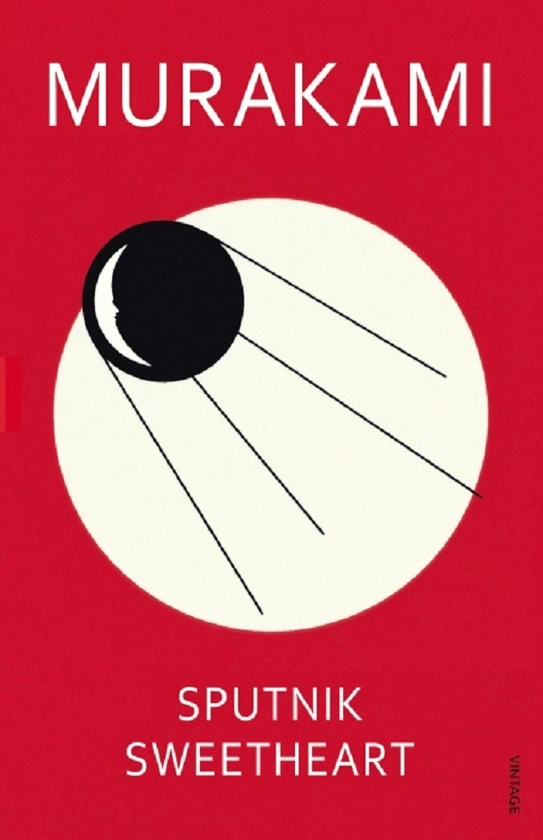
The atmosphere is quiet, nocturnal, and suspended between realism and dream. Tokyo apartments, late-night phone calls, cigarettes, manuscripts, trains, offices, and a bright Greek island all seem touched by the same sense of emotional dislocation. The title’s reference to Sputnik suggests lonely satellites moving through space, close enough to signal, too distant to touch.
The major themes include loneliness, desire, identity, writing, sexual awakening, disappearance, memory, and the limits of communication. The novel asks how much of another person can ever truly be known. It also explores the way love can awaken creativity and self-knowledge, even when it cannot be returned or completed.
The style is spare, reflective, and dreamlike, with the calm surface typical of Murakami’s fiction. Ordinary conversations gradually open into metaphysical unease. The prose moves gently, but the emotional pressure grows in the spaces between what characters say and what they cannot say. The surreal elements feel less like decorative fantasy than like the natural language of inner fracture.
What lingers after reading is the ache of incompletion. Murakami Sputnik Sweetheart does not treat disappearance only as a plot device. It becomes a metaphor for all the ways people vanish from one another: through silence, desire, trauma, self-division, or the simple impossibility of being fully understood. The book’s mystery remains powerful because it is emotional as much as literal.
This novel is for readers who enjoy literary fiction, surreal realism, quiet psychological mystery, and stories about love that cannot be easily resolved. It will appeal to an audience drawn to Murakami’s recurring concerns: lonely narrators, elusive women, strange thresholds, music, writing, memory, and the hidden spaces beneath ordinary life.
One reason to read this novel is its emotional precision. The love triangle is not melodramatic; it is full of restraint, hesitation, and silence. Each character wants something they cannot quite have, and Murakami captures that longing with tenderness rather than easy judgment.
Another reason is Sumire herself. She is awkward, intense, funny, vulnerable, and unfinished in a way that feels deeply human. Her desire for Miu is also a desire to become more fully herself, to cross from imagination into life. That makes her disappearance feel not only mysterious, but painfully symbolic.
The novel also stands out because of its balance between intimacy and strangeness. It begins with conversations about love and writing, then opens into a mystery that seems to belong to another dimension of experience. This shift gives the story its haunting aftereffect, as if the real world has briefly revealed a hidden seam.
Murakami Sputnik Sweetheart is a beautiful and unsettling choice for readers who want a novel about longing, absence, and the mysteries of connection. It invites you into a story where love is a signal sent across distance, where every person is partly unreachable, and where one disappearance illuminates the loneliness that was present from the beginning.