Відгуки і рецензії читачів
Поки немає відгуків


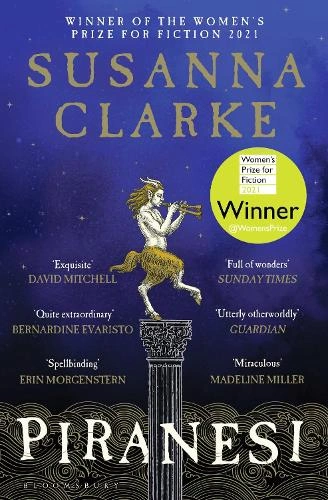
Piranesi is a haunting and luminous fantasy novel about a man living in an impossible House of endless halls, statues, tides, clouds, and secrets, where beauty feels sacred and danger begins with the smallest sign that the world is not what he believes.
Piranesi Susanna Clarke gives readers a mysterious, meditative, and deeply original story from the author of Jonathan Strange & Mr Norrell, following a gentle narrator whose careful notebooks record wonder, solitude, and the slow unraveling of a hidden truth.
The plot is told through the journals of a man known as Piranesi, who lives in the House, a vast labyrinth of halls and vestibules lined with thousands of statues. The lower levels are touched by the sea and dangerous tides, the upper halls are crossed by clouds, and the middle halls are where he walks, studies, fishes, maps, and records what he sees with patient devotion.
Piranesi believes the House is his world. He knows its tides, its birds, its statues, its drowned spaces, and the bones of the Dead, to whom he brings small offerings of respect. His life is solitary but not empty; he experiences the House as beautiful, generous, and alive with meaning. This gives the opening of the novel a strange atmosphere of peace, ritual, and reverence.
Twice a week he meets the Other, the only living person he regularly sees. The Other is searching for a great hidden knowledge, and Piranesi assists him with trust and diligence. Yet their relationship contains unease from the beginning. The Other understands more than he says, and the reader gradually senses that Piranesi’s innocence may be protecting him from a reality he has forgotten.
In the middle of the narrative, Piranesi book becomes a quiet but gripping mystery. Messages appear, evidence contradicts what Piranesi has been told, and the possibility of another person in the House raises urgent questions. Who is the new presence? What happened before the journals began? Why does the House feel both like a sanctuary and a prison?
The central conflict is not a battle in the usual fantasy sense. It is a conflict between trust and manipulation, memory and erasure, wonder and knowledge, solitude and connection. As Piranesi searches through lost texts, fragments of the past, and the strange logic of the House, he must decide what truth is worth when it may change everything he loves.
First published in 2020, Piranesi won the Women’s Prize for Fiction in 2021. Its power lies in the way Susanna Clarke turns a seemingly simple setting into an entire emotional and philosophical world, where architecture, weather, ritual, and memory all become part of the mystery.
The atmosphere is dreamlike, austere, and full of quiet awe. The House feels impossible yet precise: salt water thunders through staircases, birds nest in high places, statues watch over empty halls, and clouds drift through upper rooms. The beauty is immense, but it is never merely decorative; it shapes how Piranesi understands kindness, order, and belonging.
The main themes include solitude, imagination, memory, innocence, exploitation, identity, knowledge, and the difference between being lost and being at home. The novel asks whether a person can live meaningfully inside mystery, and what happens when the truth that restores identity also threatens a beloved vision of the world.
The style is spare, elegant, and carefully controlled. Clarke uses journal entries, dates, observations, and repeated rituals to create a voice that feels both precise and vulnerable. Piranesi’s narration is one of the novel’s great strengths: he is rational, curious, generous, and deeply attentive to the life around him.
The characters are few, but each carries strong symbolic and emotional weight. Piranesi embodies wonder and trust; the Other introduces ambition, secrecy, and control; the Dead create a moral presence inside the House; the unknown visitor suggests that the sealed world may be opening. This small cast makes every discovery feel significant.
For the audience, the novel offers fantasy without excess. Its magic is architectural, psychological, and spiritual rather than noisy. The story is short compared with many epic fantasies, but its emotional echo is large, leaving readers with questions about freedom, gratitude, loneliness, and the stories people use to survive.
This novel is ideal for readers who enjoy literary fantasy, atmospheric mysteries, philosophical fiction, and stories that reveal their secrets slowly. It suits an audience drawn to labyrinths, unreliable realities, symbolic settings, and narratives where mood and voice matter as much as plot.
It will also appeal to readers who appreciate quiet speculative fiction with emotional depth. Those who enjoyed Jonathan Strange & Mr Norrell may recognize Clarke’s fascination with other worlds, but Piranesi offers a more concentrated, intimate, and meditative experience.
Piranesi is a compelling choice for readers asking why read a fantasy novel that feels unlike anything else. It offers mystery, beauty, tenderness, and unease in equal measure, inviting you to enter the House, listen to its tides, follow its statues, and discover what remains when wonder and truth finally meet.