Відгуки і рецензії читачів
Поки немає відгуків


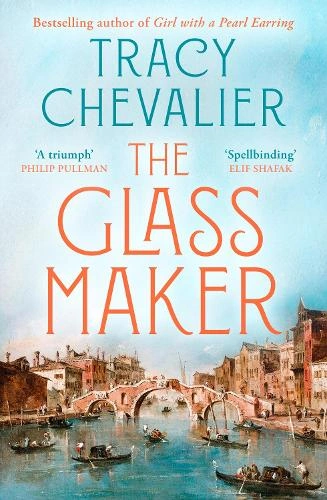
The Glassmaker is a luminous historical novel set between Venice and Murano, where fire, sand, breath, and patience become art. Beginning in 1486, the story follows Orsola Rosso, a girl born into a glassmaking family on the island where masters guard their secrets and tradition decides who is allowed to create. Her world is beautiful, restrictive, and dangerous, and the hook is irresistible: in a place where time moves differently, one woman’s hidden craft may outlast war, plague, love, loss, and the centuries themselves.
The Glassmaker Tracy Chevalier offers readers a richly imagined journey through a family, a city, and an art form that changes without ever losing its fragile brilliance. The novel combines historical fiction with a subtle, unusual treatment of time, following Orsola and the Rosso family across generations as Venice transforms from a great trading power into a city known for memory, beauty, and tourism. It is a story about making, surviving, loving, and leaving something behind that can still catch the light long after its maker is gone.
Orsola Rosso grows up on Murano, the island across the lagoon from Venice, where glassmaking is both livelihood and legacy. The craft belongs officially to men, to fathers, brothers, sons, and maestros whose skills are treated as precious family property. Orsola, however, is drawn toward the furnace and the workbench with a hunger she cannot ignore. Because she is a woman, her desire to make glass must begin in secret, shaped by observation, persistence, and quiet defiance.
The plot follows Orsola as she learns the delicate art of making beads, an area of glasswork that gives her a path into the craft without fully breaking the visible rules of her society. Her work is small in size but enormous in meaning. A bead can travel farther than its maker, pass through hands and borders, and carry the brilliance of Murano into the wider world. Through this craft, Orsola finds a way to support her family, assert her skill, and claim a place in a tradition that was not designed to welcome her.
The novel’s structure is one of its most distinctive features. Time skips forward like a stone across water, touching different centuries while allowing Orsola and those around her to remain connected to the long life of Venice. Through this device, the story moves through eras of trade, illness, war, artistic change, and modern transformation. The characters age differently than history around them, which gives the book a dreamlike quality while still grounding it in the material reality of glass, labor, family, and survival.
In the middle of the narrative, The Glassmaker book becomes more than the portrait of one craftswoman. It becomes an exploration of what it means to endure when history keeps remaking the world. Orsola’s family must face financial pressure, shifting markets, personal grief, and the expectations placed on women. The conflict is not only external; it also lives inside Orsola, who must decide how much of herself to sacrifice for family duty and how much she is willing to risk for the work that gives her life shape.
The characters are bound to Murano by blood, trade, rivalry, pride, and love. Orsola’s journey sits at the center, but the wider family story gives the novel its depth. The island’s glassmakers are artists and workers at once, dependent on fire and secrecy, on beauty and commerce. Venice glitters nearby, yet Murano has its own rhythm, its own dangers, and its own understanding of time. Together, they create a setting where every object made by hand feels like a small act of resistance against disappearance.
The atmosphere is immersive, elegant, and filled with the textures of Venetian life. Furnaces blaze, canals shift with reflected light, workshops hum with concentration, and the lagoon becomes a boundary between worlds. The novel captures the beauty of glass without turning it into decoration only; every finished piece carries heat, risk, skill, and the labor of bodies that must work close to fire.
The major themes include creativity, gender, inheritance, family duty, time, mortality, and the endurance of art. Orsola’s struggle to become a maker in a male-dominated craft gives the story a strong emotional core, while the centuries-long sweep expands that struggle into something larger. The book asks what survives when cities change, when loved ones are lost, and when the work of women is pushed into the margins of history.
The style is graceful, visual, and carefully crafted, with a rhythm suited to a story about artistry and patience. The historical detail gives the world weight, while the time-skipping structure adds wonder and momentum. Rather than moving in a straight line, the novel creates the feeling of looking through layered glass: each century reveals another color, another fracture, another reflection of the same enduring life.
What lingers after reading is the connection between fragility and permanence. Glass can shatter, but it can also survive for centuries. A city can decline and still remain unforgettable. A woman denied recognition can still leave evidence of her hand in the world. That tension gives the novel its emotional power and makes Orsola’s story feel both intimate and expansive.
This novel is for readers who enjoy historical fiction with a strong sense of place, a memorable heroine, and an inventive approach to time. It will appeal to an audience interested in Venice, Murano glass, women artists, family sagas, and stories where craft is not background but the soul of the narrative. Readers who appreciate slow-burning beauty, emotional depth, and richly researched worlds will find much to admire.
One reason to read this novel is Orsola’s quiet determination. She does not conquer her world through dramatic rebellion alone; she learns, adapts, works, and insists on her own creative life even when custom limits her. Her strength grows through attention and patience, which makes her journey feel deeply human.
Another reason is the setting. Murano is not treated as a picturesque backdrop but as a living place shaped by trade, secrecy, skill, and dependence on the wider fortunes of Venice. The island’s glassmaking tradition gives the story both beauty and tension, because every object made there represents artistic excellence and economic survival at the same time.
The novel also stands out because of its treatment of time. By moving across centuries while keeping emotional continuity, it creates a rare sense of history as something both vast and personal. Wars, epidemics, changing fashions, and modern pressures pass over the characters, yet the act of making remains a thread connecting them to one another and to the reader.
The Glassmaker is a thoughtful and enchanting choice for readers who want a novel of craft, place, and endurance. It invites you into the heat of the furnace and the shimmer of the lagoon, where one woman’s secret skill becomes part of a much larger story about beauty, survival, and the fragile things that last.