Відгуки і рецензії читачів
Поки немає відгуків


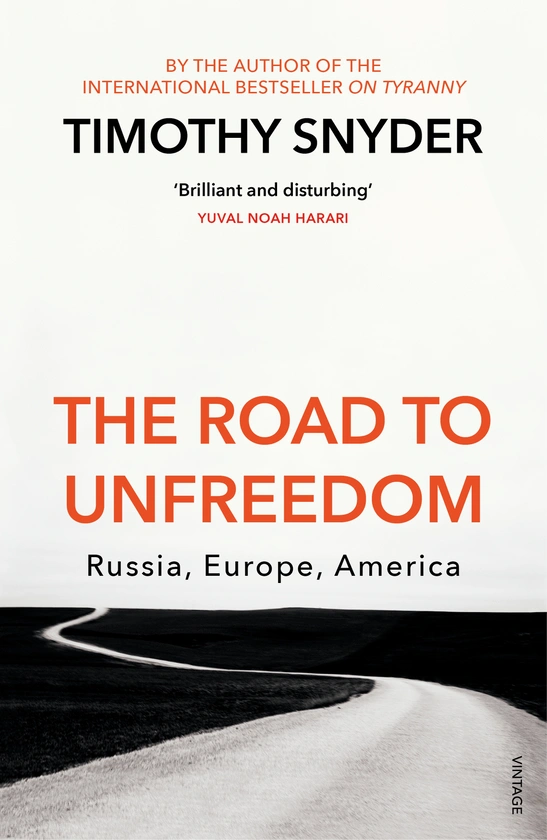
The Road to Unfreedom : Russia, Europe, America is a forceful work of contemporary history about authoritarianism, propaganda, empire, and the fragile choices that determine whether societies remain free. Timothy Snyder examines how ideas that once seemed buried in the twentieth century returned through modern Russian politics, the war against Ukraine, interference in European and American democracy, and the deliberate replacement of truth with spectacle. The book’s central warning is urgent: the future is not guaranteed to be liberal, democratic, or rational unless citizens understand how unfreedom is built.
The Road to Unfreedom : Russia, Europe, America Timothy Snyder gives readers a sharp and unsettling analysis from a historian known for his work on Eastern Europe, totalitarianism, and the politics of memory. First published in 2018, the book connects Russia’s invasion of Ukraine in 2014, the rise of far-right movements in Europe, the 2016 U.S. presidential campaign, cyberwar, oligarchy, and political myth into one argument about how democracies can be weakened from within.
The book begins from a rejection of the comforting belief that history naturally moves toward freedom. After the Cold War, many observers assumed that liberal democracy had won and that globalization would bring peaceful progress. Snyder argues that this confidence was misplaced. Instead of an inevitable future of openness, the world entered a period in which authoritarian leaders learned to exploit disappointment, inequality, and digital confusion.
At the center of the analysis is Russia under Vladimir Putin. Snyder examines how Russian political thought and state practice turned away from a politics of future improvement and toward what he describes as a politics of eternity: a world of permanent enemies, historical grievance, mythic victimhood, and staged conflict. In this framework, truth matters less than emotional control, and politics becomes a performance designed to keep citizens fearful and loyal.
The plot of the argument moves from Russia into Ukraine, Europe, and the United States. Ukraine is crucial because its democratic aspirations challenged the Kremlin’s imperial vision. The 2014 revolution, the annexation of Crimea, and the war in eastern Ukraine become key moments in Snyder’s explanation of how Russian power sought to deny Ukrainian sovereignty while testing methods of disinformation, destabilization, and political manipulation.
In the middle of the narrative, The Road to Unfreedom : Russia, Europe, America book becomes a study of how lies travel. Snyder connects propaganda, cyber operations, financial influence, media distortion, and support for extremist politics into a broader strategy aimed at weakening trust in democratic institutions. The conflict is not only military or diplomatic. It is also epistemological: a struggle over whether citizens can still recognize facts, responsibility, and shared reality.
The book also turns toward Europe and America, showing how democratic societies became vulnerable to oligarchy, resentment, and theatrical politics. Snyder links foreign influence with internal weakness, arguing that authoritarian ideas succeed when citizens lose faith in equality, institutions, journalism, law, and the possibility of a better future. The danger, in his view, is not only what Russia does, but what democracies fail to defend in themselves.
The atmosphere is urgent, analytical, and disturbing. Snyder writes with the intensity of a historian who believes that the events he describes are not remote abstractions, but active threats to democratic life. The book moves through recent history with a sense of warning, showing how quickly political language, media habits, and public expectations can be reshaped by those who benefit from confusion.
The major themes include freedom, tyranny, oligarchy, truth, empire, nationalism, propaganda, democracy, inequality, and historical memory. The book contrasts political possibilities such as equality versus oligarchy, individualism versus totalitarianism, and truth versus lies. Its deepest concern is the loss of a future: the moment when societies stop imagining reform and begin accepting permanent crisis as normal.
The style is dense, argumentative, and polemical, combining contemporary political analysis with historical interpretation. Snyder does not write as a neutral chronicler of headlines. He builds a thesis about how authoritarian power works in the twenty-first century, using events in Russia, Ukraine, Europe, and America to show a connected pattern. The result is challenging, sometimes provocative, and designed to make the reader reassess assumptions about recent history.
What lingers after reading is the book’s insistence that freedom is not a default condition. The Road to Unfreedom : Russia, Europe, America argues that democracy requires truth, institutions, equality, and a believable future. When those foundations weaken, citizens become easier to manipulate through fear, nostalgia, conspiracy, and the false comfort of strongman politics.
This book is for readers interested in contemporary history, Russia, Ukraine, authoritarianism, geopolitics, democracy, media manipulation, and the crisis of liberal institutions. It will appeal to an audience that wants a serious political argument rather than a simple news summary, especially readers who want to understand how events in Moscow, Kyiv, Brussels, London, and Washington became interconnected.
One reason to read this book is its focus on Ukraine as central to understanding modern political conflict. Snyder does not treat Ukraine as a side issue. He shows it as a decisive arena where democracy, sovereignty, empire, and propaganda collided, making the country essential to the story of Europe’s future.
Another reason is the book’s analysis of truth. Snyder argues that authoritarianism does not always need citizens to believe one official lie. It may be enough to make them doubt everything, distrust institutions, and retreat into cynicism. That insight gives the book particular force in an age of digital manipulation and political spectacle.
The book also stands out because it connects external influence with internal democratic weakness. It warns that propaganda works best where inequality, corruption, polarization, and distrust have already prepared the ground. This makes the book not only a study of Russia’s strategy, but a challenge to democratic societies to renew themselves.
The Road to Unfreedom : Russia, Europe, America is a compelling choice for readers who want a serious, urgent, and historically grounded account of the struggle between democracy and authoritarianism in the modern world. It invites you to look beyond daily headlines and consider the larger conflict over truth, power, memory, and the future that free societies must still choose to defend.