Відгуки і рецензії читачів
Поки немає відгуків


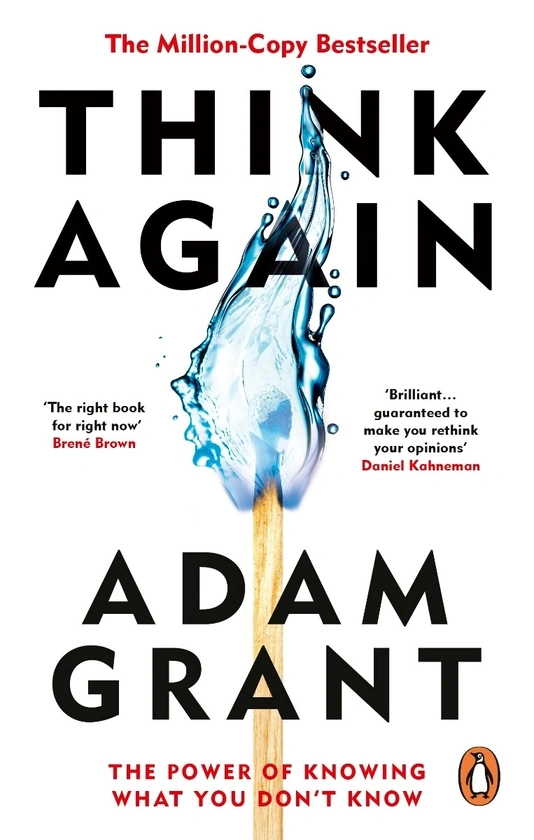
Think Again: The Power of Knowing What You Don't Know is a practical and thought-provoking nonfiction book about the art of rethinking: questioning old assumptions, updating beliefs, and staying mentally flexible in a world that changes faster than our opinions often do. Adam Grant argues that intelligence is not only the ability to think and learn, but also the willingness to unlearn what no longer serves us. The hook is simple and powerful: if you can change your mind when the evidence changes, you can become wiser, more adaptable, and more useful to others.
Think Again: The Power of Knowing What You Don't Know Adam Grant offers readers a research-based guide from an organizational psychologist and bestselling author whose work focuses on motivation, leadership, culture, and change. First published in 2021, the book blends psychology, storytelling, workplace insight, and real-world examples to show why certainty can be dangerous and why intellectual humility may be one of the most important skills of modern life.
The book begins with a challenge to a familiar habit: people often update their devices, wardrobes, homes, and professional tools, but keep outdated beliefs for years. Grant asks why opinions formed long ago can feel like identity, even when new evidence suggests they should be revised. His answer is not to abandon conviction entirely, but to treat thinking as a process that needs regular maintenance.
At the center of the book is the idea of rethinking. Grant explores why people cling to familiar views, defend mistakes, and resist feedback even when it could help them grow. He contrasts mental flexibility with overconfidence, showing how the need to be right can block learning. The plot of the argument moves from individual habits to conversations with others and then to cultures that either reward curiosity or punish doubt.
Grant introduces memorable ways to understand how people think. He describes mindsets that can make us act like preachers defending sacred beliefs, prosecutors attacking other people’s ideas, or politicians trying to win approval. Against these habits, he recommends thinking more like a scientist: forming hypotheses, testing assumptions, accepting uncertainty, and revising conclusions when better evidence appears.
In the middle of the book, Think Again: The Power of Knowing What You Don't Know book becomes especially useful for relationships, leadership, and difficult conversations. Grant shows that changing someone’s mind is rarely a matter of overwhelming them with facts. It often requires listening, asking better questions, lowering defensiveness, and helping people discover their own reasons to reconsider. The conflict is not between intelligence and ignorance, but between rigidity and curiosity.
The book also examines collective rethinking. Teams, schools, companies, and communities can become trapped by old strategies if they value confidence more than learning. Grant argues for cultures where people are encouraged to challenge assumptions, admit what they do not know, and treat disagreement as a tool for improvement. The strongest organizations are not those where everyone sounds certain, but those where people can revise course before failure becomes expensive.
The atmosphere is energetic, accessible, and intellectually curious. Grant writes for readers who want ideas they can apply, not only theories to admire. The book moves through research findings, stories, examples from business and public life, and practical moments of self-reflection. Its tone is encouraging rather than scolding: rethinking is presented not as weakness, but as strength.
The major themes include intellectual humility, curiosity, adaptability, learning, persuasion, leadership, feedback, identity, and decision-making. The book asks readers to separate confidence from certainty and to understand that being wrong is not the opposite of intelligence. Often, it is the beginning of better thinking.
The style is clear, story-driven, and grounded in behavioral science. Grant uses examples to make psychological ideas easy to understand, then turns them into habits readers can practice. The chapters are structured to keep the pace moving, with insights that connect personal growth to workplaces, classrooms, families, and public debate.
What lingers after reading is the idea that changing your mind can be an act of integrity. Think Again: The Power of Knowing What You Don't Know does not celebrate indecision or endless doubt. It argues for confident humility: caring enough about truth to revise your views, and caring enough about people to help them do the same without humiliation.
This book is for readers interested in psychology, leadership, communication, self-development, education, and better decision-making. It will appeal to an audience that wants to become more open-minded without becoming passive, more persuasive without becoming aggressive, and more adaptable without losing personal values.
One reason to read this book is its practical approach to uncertainty. Grant shows that admitting “I might be wrong” is not a failure of intelligence. It can be the first step toward stronger judgment, better relationships, and smarter choices. That makes the book valuable not only for professional life, but for personal conversations where defensiveness often blocks understanding.
Another reason is the focus on helping others rethink. The book does not stop at self-improvement. It explores how to create conversations where people feel less attacked and more willing to reconsider. This makes it useful for anyone who deals with disagreement, whether at work, in family life, in education, or in public discussion.
The book also stands out because it treats learning as an ongoing identity. Instead of defining ourselves by being right, Grant encourages readers to define themselves by the willingness to improve. That shift can change how we respond to criticism, failure, new evidence, and people who see the world differently.
Think Again: The Power of Knowing What You Don't Know is a smart and useful choice for readers who want to keep their thinking fresh in a complicated world. It invites you to loosen your grip on outdated certainty, ask better questions, and discover the freedom that comes from knowing that the best minds are not those that never change, but those that keep learning.